Materials to Megawatts: The Chemistry and Circuitry Behind Renewable Energy Systems
Ange Compere1 and Georgina Tobon-Hernandez1
ENGL 210-Writing for Engineering | Professor Adam Bubrow
1The Grove School of Engineering, The City College of New York, New York, NY
Abstract:
Since the industrial revolution in the 1950s, human activities have contributed to climate change by adding carbon dioxide (CO2) and other heat-trapping greenhouse gases to the atmosphere. These emissions have increased the greenhouse effect, a process in which certain gases trap heat and caused the Earth’s temperature to rise (EPA, 2017). In 2024, the global average surface temperature reached a record high of 2.32° F above the 20th-century average (Climate.gov, 2025). The primary human activity driving the amount and rate of climate change is the burning of fossil fuels (EPA, 2017).
Because of these impacts, the world is increasingly turning to renewable energy sources such as solar, water, and organic waste. Renewable energy reduces dependence on fossil fuels, limiting greenhouse gas emissions, and strengthens long-term energy security. Unlike coal or oil, renewable sources replenish naturally and produce far fewer environmental pollutants (International Energy Agency, 2023).
Chemical engineers advance renewable energy by designing the materials, purification systems, and chemical pathways that allow these technologies to run efficiently. Meanwhile, electrical engineers focus on converting this harvested energy into usable power and delivering it reliably to the grid. Together, these disciplines work to develop systems that capture energy from sustainable sources and ensure that it is efficiently transformed into electricity.

Solar Energy
Humans have been using the sun as an energy source for centuries. Early uses ranged from harnessing sunlight to start fires to more modern applications such as powering everyday electrical equipment (National Grid, 2023). Today, technologies like photovoltaic (PV) panels and concentrating solar- thermal power (CSP) enable us to generate electricity directly from sunlight.
Chemical Engineering in Photovoltaic Materials
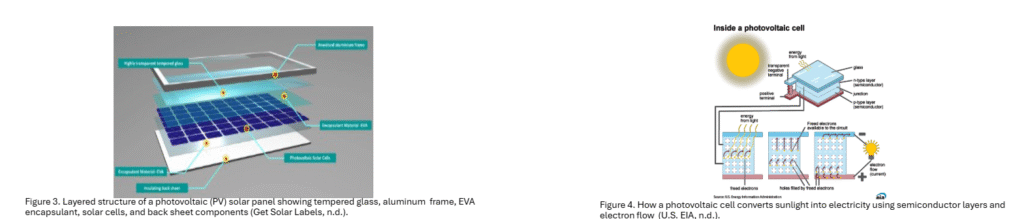
Solar panels produce electricity using photovoltaic (PV) cells, which convert sunlight into electric current through the photoelectric effect. A PV cell is composed of semiconductor materials—typically silicon—that have been changed through doping, a chemical process that introduces other atoms to create regions with either excess positive or negative charge (Fraunhofer Institute for Solar Energy Systems, 2022).
Chemical engineers design and optimize several aspects of PV materials, including:
- Thin–film coatings that reduce reflection and increase light absorption
- Passivation layers that prevent electron recombination
- Material deposition techniques (e.g., chemical vapor deposition)
- Recycling processes for end-of-life solar panels to recover silicon, silver, and rare metals
These advancements improve panel durability, increase efficiency, and reduce manufacturing costs (Green et al., 2021).
How Does Sunlight Become Electricity?
A photovoltaic cell (PV), commonly called a solar cell, is a non-mechanical device that converts sunlight directly into electricity. Some PV cells can also convert artificial light. When photons strike the semiconductor material, they may be reflected, pass through the material, or be absorbed. Only absorbed photons provide energy to generate electricity.
When the semiconductor absorbs sunlight, electrons are dislodged from their atoms. The movement of these electrons—each carrying a negative charge—toward the top layer of the cell creates an electrical imbalance charge between the top and bottom surfaces. This imbalance creates a voltage potential, similar to the positive and negative terminals of a battery (U.S. Energy Information Administration, 2024).
This voltage drives a direct current (DC) through the cell’s wiring. The DC electricity is then sent to an inverter, which converts it into alternating current (AC) for household and grid use (National Grid, 2023).
Hydropower
The primary source of hydroelectric power is water. Since ancient times, humans have used moving water as a source of mechanical power. In medieval societies, waterwheels powered industries such as grain and textile mills. Over time, technology progressed from mechanical waterwheels to modern systems that use water energy to generate electricity.

Water & Hydropower: Chemical Engineering in Fluid and Purification Systems
Hydropower relies on the controlled movement of water through turbines, where kinetic energy is converted into mechanical rotation and eventually electricity. Chemical engineers support hydropower systems by designing water purification, filtration, and sediment removal processes that maintain the consistent water quality required for turbine operation.
Poor water quality can lead to scaling, corrosion, or mechanical damage within turbines. To prevent these issues, chemical engineers apply principles of fluid dynamics, water chemistry, and materials selection to ensure continuous flow and long equipment lifespan (U.S. Department of Energy, 2023).
Chemical engineers also contribute to water-energy nexus research, which explores how water availability influences energy production and how modern energy systems depend on water treatment and management.
Hydroelectric Power: How Water Motion Generates Electricity
Hydropower depends on the natural water cycle, which involves three main steps:
- Evaporation: Solar energy heats surface water, causing it to evaporate.
- Condensation: Water vapor cools and condenses to form clouds, eventually falling as precipitation such as rain or snow.
- Collection: Precipitation collects in rivers, lakes, and reservoirs, where gravity drives the flow of water downstream.
This moving water is what powers the turbines in a hydropower system. For this reason, hydroelectric power plants are built near water sources, where both the volume of water flow and the change in elevation—known as the head—determine the amount of available energy. In general, the greater the water flow and the higher the head, the more electricity a hydropower plant can generate (EIA, 2023).
As water travels through a pipe or penstock, it pushes against the blades of a turbine, causing it to spin. The spinning turbine turns a shaft connected to a generator. Inside the generator, coils of wire rotate within a magnetic field, converting the turbine’s mechanical energy into electrical energy (Water Science School, 2018).
Waste-to-Energy Electricity
The primary source for waste-to-energy (WtE) systems is municipal solid waste (MSW), commonly known as trash and garbage. Historically, people burned waste simply as a means of disposal, occasionally using the heat for basic tasks like cooking or sanitation. However, the potential to convert this heat into usable, stable electricity had not yet been realized. Today, modern WtE facilities use highly controlled and optimized systems that convert the thermal energy of burning waste into steam, and then into electric power through turbine-driven generators.

Waste-to-Energy: Chemical Processes That Convert Waste Into Fuel
Waste-to-energy (WtE) technologies transform municipal or agricultural waste into usable energy through controlled chemical reactions. A central process is anaerobic digestion, where microorganisms break down organic material without oxygen to produce biogas, a mixture primarily composed of methane (CH₄) and carbon dioxide (CO₂) (EPA, 2024).
Chemical engineers optimize several aspects of this process, including:
- Digester conditions (temperature, pH, retention time)
- Pre–treatment methods that increase the efficiency of organic breakdown
- Gas purification systems that remove hydrogen sulfide and moisture
- Combustion processes that converting purified biogas into heat for turbines
Because methane has high energy content, WtE facilities can supply stable power while simultaneously reducing landfill waste—making this technology a growing part of sustainable infrastructure.
Waste-to-Energy: From trash to Power
A second major WtE pathway involves incineration, often called a mass-burn system, which is the most common method used today. In this process, MSW is sorted, prepared, and fed into an incinerator. The waste is burned in a controlled environment, releasing heat that boils water in a steam boiler. The resulting high-pressure steam spins the blades of a turbine generator, producing electricity.
The entire process can be understood as a chain of energy conversions:
- Chemical energy (stored in waste)
Thermal Energy (heat from burning).
- Thermal Energy (in boiler)
Thermal energy (in high-pressure steam).
- Thermal Energy (steam)
Mechanical Energy (spinning turbine rotor).
- Mechanical Energy
Electrical Energy (in the generator).
Both anaerobic digestion and mass-burn incineration demonstrate how waste—once viewed only as pollution—can be transformed into a valuable and renewable source of power.
Conclusion
Renewable energy technologies are essential for addressing climate change, strengthening energy security, and reducing dependence on fossil fuels. Chemical engineers play a critical role in developing the materials, purification systems, and chemical processes that make solar, hydropower, and waste-to-energy systems efficient and reliable. Electrical engineers complement this work by converting harvested energy into usable electricity and ensuring that power is safely delivered to homes and the grid. Together, these disciplines drive the transition toward cleaner and more sustainable energy systems. As global demand for energy continues to rise, the combined efforts of chemical and electrical engineers will remain vital in shaping a more resilient and environmentally responsible future.
References
Abalasei, M. E., Toma, D., Dorus, M., & Teodosiu, C. (2025). The impact of climate change on water quality: A critical analysis. Water, 17(21). https://doi.org/10.3390/w17213108
Chemicals.co.uk. (n.d.). GCSE chemistry: How to purify water. https://www.chemicals.co.uk/blog/gcse-chemistry-how-to-purify-water
ERG Environmental Services. (n.d.). Biomass explained. https://ergenvironmental.com/industry-news-blog/biomass-explained/
Fraunhofer Institute for Solar Energy Systems. (2022). Photovoltaics report. Fraunhofer ISE.
Green, M. A., Dunlop, E. D., Hohl-Ebinger, J., Yoshita, M., Kopidakis, N., & Hao, X. (2021). Solar cell efficiency tables (Version 57). Progress in Photovoltaics: Research and Applications, 29(1), 3–15. https://doi.org/10.1002/pip.3371
International Energy Agency. (2023). World energy outlook 2023. IEA.
Lindsey, R., Dahlman, L., & Blunden, J. (2025). Climate change: Global temperature. Climate.gov. https://www.climate.gov/news-features/understanding-climate/climate-change-global-temperature
National Grid. (2023). How do solar panels work? https://www.nationalgrid.com/stories/energy-explained/how-do-solar-panels-work
U.S. Department of Energy. (2023). Hydropower basics. Office of Energy Efficiency & Renewable Energy. https://www.energy.gov/eere/water/hydropower-basics
U.S. Energy Information Administration. (2023). Hydropower explained. https://www.eia.gov/energyexplained/hydropower/
U.S. Energy Information Administration. (2024) Biomass Explained. https://www.eia.gov/energyexplained/biomass/waste-to-energy-in-depth.php
United States Environmental Protection Agency. (2017). Causes of climate change. EPA. https://19january2017snapshot.epa.gov/climate-change-science/causes-climate-change_.html
United States Environmental Protection Agency. (2024). Overview of anaerobic digestion. https://www.epa.gov/anaerobic-digestion
U.S. Geological Survey. (2018). Hydroelectric Power: How it Works. Water Science School. https://www.usgs.gov/water-science-school/science/hydroelectric-power-how-it-works

