Street Craps: A game of probability
This report details the probabilistic analysis of the luck or math aspect in the game of Craps. Craps involve sequential dice rolls, requiring the application of conditional probability to model outcomes accurately. The analysis separates the game into two phases: The come-out roll and the Point roll. By calculating the probabilities of getting the winning number 7 or 11, we can determine the winning chance of a player. We use this method to explain how street Craps is just a game of probability, not of luck.
Introduction
Probability is the branch of mechanics concerning numerical descriptions of how likely an event is to occur or how likely it is that a proposition is true. As stated by Sheldon M. Ross in Introduction to Probability and Statistics for Engineers and Scientist, “The concept of probability of a particular event of an experiment is subject to various meaning and interpretation”, meaning that a probability represents a chance not a certainty. Dice games, like all forms of gambling games, are fundamentally games of chance.
Craps is a dice game played with two standard six-sided dice. The origin of the popular casino game dates to the time of the Crusades, when it was known as the Hazzard. It grew in popularity in 17th-century France and finally came to the United States via New Orleans as a street game called street craps. Although the American version of Craps has undergone a few minor rule changes over the years, the game’s core gameplay remained the same.
The objective of this analysis is to use mathematical probability to determine odds of winning within the first stage. This investigation will rely on the combination of outcomes possible when rolling two six-sided dice, where the total number of equally likely outcomes is 6 * 6 = 36.
|
Sum |
Possible Rolls |
Count |
Probability (x/36) |
|
2 |
(1,1) |
1 |
1/36 |
|
3 |
(1,2), (2,1) |
2 |
2/36 |
|
4 |
(1,3), (2,2), (3,1) |
3 |
3/36 |
|
5 |
(1,4), (2,3), (3,2), (4,1) |
4 |
4/36 |
|
6 |
(1,5), (2,4), (3,3), (4,2), (5,1) |
5 |
5/36 |
|
7 |
(1,6), (2,5), (3,4), (4,3), (5,2), (6,1) |
6 |
6/36 |
|
8 |
(2,6), (3,5), (4,4), (5,3), (6,2) |
5 |
5/36 |
|
9 |
(3,6), (4,5), (5,4), (6,3) |
4 |
4/36 |
|
10 |
(4,6), (5,5), (6,4) |
3 |
3/36 |
|
11 |
(6,5), (5,6) |
2 |
2/36 |
|
12 |
(6,6) |
1 |
1/36 |
Figure 1: Probability of 36 rolls
The Rules of Street Craps
The rules are simple. To play, you must determine who the shooter is and the player, set up a pot (the stake) and proceed to the stages. The game is played in two stages: Stage 1 the come-out roll and Stage 2 the point roll.
Stage 1: The Come-Out Roll
The shooter has the dice. The outcomes of this first roll determine the immediate results or the progression to the next stage:
- Shooter wins: roll a 7 or 11 to win the pot;
- Player wins (Craps): rolls a 2,3 or 12; the player wins the pot.
- Proceed to Stage 2: rolls a 4, 5, 6, 8, 9 or 10, the pot is safe, and it establishes a point number.
In the case in which the shooter or the player wins if either participant wants to continue playing, the loser must reset the pot.
Stage 2: The Point Roll
If the shooter comes out with a 4, 5, 6, 8, 9, or 10, that number becomes their point number. Meaning they must reroll that number to win the game.
- Shooter Wins: The shooter must roll the Point Number again to win the pot.
- Shooter Loses (Seven-Out): If they roll 7, the opponent wins the pot, and they lose the dice.
If they want to continue the game in that case, they must reset the pot and go back to stage 1.
Materials and Methods
Materials:
- Virtual dice website
- Excel
Methods:
- For this experiment, the use of an online dice rolling website Statistics of rolling dice | Academo.org – Free, interactive, education. instead of an actual pair of dice to recreate the dice roll for the sake of convenience. This will allow the experiment to be more accurate as human error will not be present during the actual rolling of the dice.
- To record the data, you must enter the number of sides and the number of dice used.
- Then press roll.
- Once the pair of dice is rolled, record the number in an excel spreadsheet and repeat step 3, 100 times.
Results
After completing 100 rolls using the virtual dice, the distribution of the roll sums deviated from the ideal theoretical distribution, as expected in any limited experiment. The key experimental findings, as detailed in Figure 3, were:
- Highest Frequency: The sum of 9 was rolled the most, occurring 17 times out of 100. Theoretically, 7 should be the highest with the highest number of combinations 6/36 in 36 rolls.
- Winning Rolls (7 or 11): The immediate winning rolls occurred 9 + 2 = 11 times (11/100).
- Losing Rolls (2, 3, or 12): The immediate losing rolls (Craps) occurred at 1 + 8 + 5 = 14 times (14/100).
- Point Established Rolls (4, 5, 6, 8, 9, 10): Rolls that sent the game to Stage 2 occurred 13 + 10 + 14 + 13 + 17 + 8 = 75 times (75/100). Meaning out of 100 rolls, you are more likely to play stage 2.
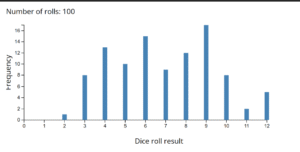
Figure 2: Graph of 100 roll
Analysis
This analysis separates the game into two parts: a look at the Come-Out Roll to test the hypothesis, and the calculation of the overall game’s probability to prove the mathematical structure of Craps.
Stage 1: The Come-Out Roll (Testing the Hypothesis)
The initial hypothesis stated that the most probable outcome of the Come-Out Roll is to establish a Point and proceed to Stage 2. Based on the table below, this hypothesis was proved wrong. The probability of proceeding to the next stage is 75%.
|
Roll Sum |
Probability (x/36) |
Probability (x/100) |
|
7 |
6/36 |
9/100 |
|
11 |
2/36 |
2/100 |
|
2 |
1/36 |
1/100 |
|
3 |
2/36 |
8/100 |
|
12 |
1/36 |
5/100 |
|
4 |
3/36 |
13/100 |
|
5 |
4/36 |
10/100 |
|
6 |
5/36 |
14/100 |
|
8 |
3/36 |
13/100 |
|
9 |
4/36 |
17/100 |
|
10 |
3/36 |
8/100 |
Figure 3: Table of Probability of roll
Conclusion on Hypothesis: The hypothesis is proved wrong by both the theoretical calculation and the experimental data. Theoretically, you are twice as likely to establish a point than to have the roll immediately end. Our 100-roll experiment exaggerated this effect, with 75% of the rolls resulting in a Point being set.
Experimental Luck vs. Theoretical Probability
The specific results from your 100 rolls, like the fact that 9 was the highest-rolled number (17 times) instead of 7 (which only appeared 9 times), are examples of random chance or “luck.” In any small sample size, the results will “skew” away from the theoretical perfect curve. However, when we group the results into the three game categories (Win/Loss/Point), the theoretical mechanics shine through: most of the time, the game moves to Stage 2.
Stage 2: The Conditional Probability of Winning (The True Odds)
As both our theoretical analysis and the experimental data strongly show, the shooter is overwhelmingly likely to establish a Point and proceed to Stage 2. Since this is the most common outcome, the simple probabilities of the Come-Out Roll are not enough to determine your overall chance of winning. The game’s structure successfully channels the shooter into this more complex phase, which requires calculating conditional probability.
The overall winning probability is the sum of winning immediately (7 or 11) PLUS the probability of winning with each possible Point (4, 5, 6, 8, 9, 10).
Conclusion
This experiment and analysis clearly demonstrate that Street Craps is not a game of simple “luck,” but a game of mathematical probability.
While our individual 100-roll experiment showed the random nature of chance (for example, the sum of 9 came up more than the sum of 7), the overall structure of the game is determined by the theoretical odds of two fair dice (x/36) . Our initial hypothesis was opposed: the most likely outcome of the Come-Out Roll is to establish a Point, leading to Stage 2. Which lowers your chances of an easy win as you must roll the point established twice. The game rules are specifically designed to push the players into the second stage with only 8 winning combinations; the odds of winning in the first round are low. In the second stage, which is a complex stage, the odds shift slightly against the shooter for a Seven-Out.
Now you know the real odds, are you ready to make a buck off the street?

